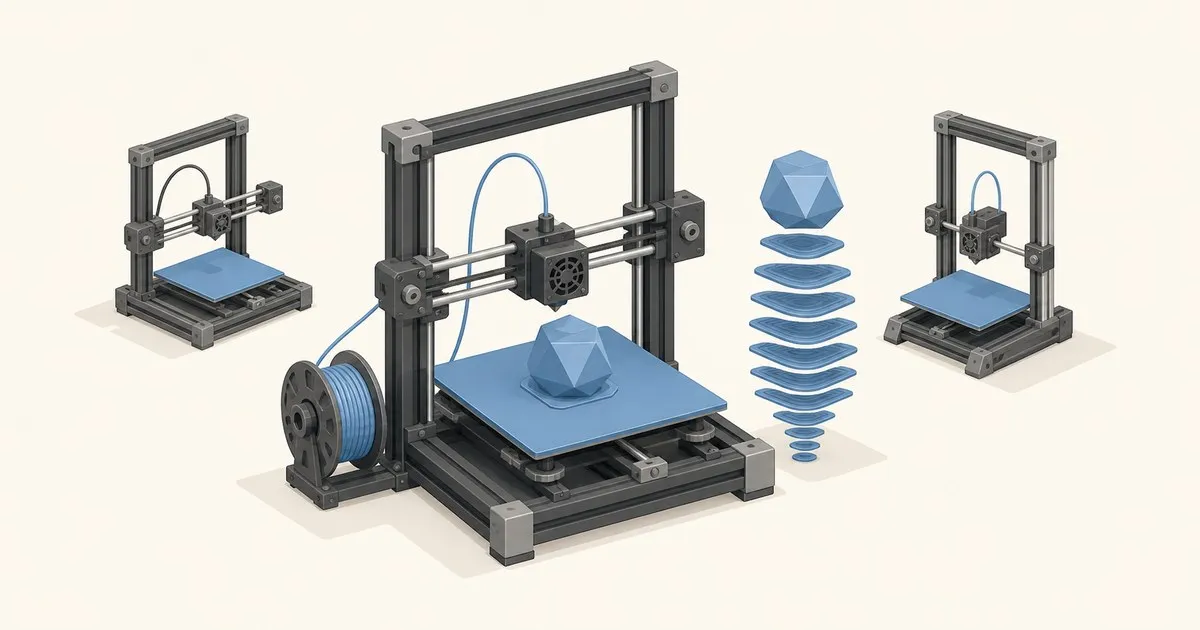
Best Slicer for Ender 3 in 2026: Model-by-Model Guide
Compare OrcaSlicer, Cura, Creality Print, and PrusaSlicer for the original Ender 3, V2, V3 SE, and V3 KE, with model-specific recommendations.
The best slicer for Ender 3 2026 depends on the specific Ender 3 model. A stock original Ender 3 on Marlin firmware, an Ender 3 V2, an Ender 3 V3 SE, and an Ender 3 V3 KE are four different machines wearing the same product name, and they do not use the same slicer settings or the same software. This guide breaks down what fits each one: OrcaSlicer, Creality’s own Creality Print, UltiMaker Cura, and PrusaSlicer with community profiles.
Why “Ender 3” isn’t one answer
Creality has shipped the Ender 3 name across a Bowden-tube 8-bit board original, a silent-board V2, and two very different current models. The Ender 3 V3 KE is a CoreXZ, direct-drive, Klipper-based machine with an advertised max speed of 500 mm/s and 8000 mm/s² acceleration. The Ender 3 V3 SE is the budget sibling: direct drive, but capped around 250 mm/s advertised (180 mm/s typical) and 2500 mm/s² acceleration. Neither shares a mainboard architecture with the Marlin-based original Ender 3 or V2, which are Bowden-fed and realistically tuned for 60-100 mm/s outer wall speeds regardless of what a slicer’s speed slider allows.
That hardware split is why “best slicer” splits into two questions: which slicer has a maintained profile for the specific model, and which slicer’s calibration tools match the printer’s firmware (Marlin vs. Klipper).
OrcaSlicer: the default pick for V3 SE and V3 KE
For the Klipper-based V3 SE and V3 KE, OrcaSlicer is the strongest fit. Creality’s own wiki documents importing the Ender-3 V3 profile directly into OrcaSlicer’s printer selector, and the project maintains active development with recent additions like Happy Hare filament-sync support for multi-material Klipper setups, per the project’s GitHub release notes.
The reason OrcaSlicer earns the recommendation over Creality Print for tuning work is calibration depth. The Calibration menu provides built-in flow rate (coarse then fine pass), pressure advance (line or pattern method), temperature tower, retraction, and max volumetric speed tests, with no external STL downloads or manual spreadsheet tracking. For Klipper machines specifically, OrcaSlicer’s adaptive pressure advance feature (Klipper firmware from July 2024 onward recommended) supports PA tests across a range of accelerations and speeds, then has the slicer compute a fitted PA model instead of a single fixed value. This is useful on a printer like the V3 KE that actually reaches acceleration and speed extremes where a single PA number stops being accurate.
Setup for either V3 model consists of choosing “Creality” as the vendor in the printer wizard, selecting Ender-3 V3 SE or Ender-3 V3 KE, and confirming the nozzle diameter. If an exact submodel is not listed, Creality’s wiki and community repos (search Printables or GitHub for “orca-profile” plus the model) fill gaps faster than waiting on upstream.
Creality Print: least friction, less calibration depth
Creality Print is Creality’s first-party slicer, rebuilt from version 5.0.0 onward as a fork of OrcaSlicer (which itself descends from Bambu Studio and PrusaSlicer). It natively supports Creality’s full FDM lineup, including Ender, CR, K1/K1C/K1 Max, and K2 series, with profiles that do not need importing.
Creality Print suits users who want zero-setup on a V3 SE, V3 KE, or K-series machine without chasing calibration precision. It shares OrcaSlicer’s UI DNA since it is a fork, but Creality’s release cadence and calibration feature parity lag the upstream OrcaSlicer project, so OrcaSlicer stays the better tool for running temperature towers and PA sweeps regularly, even on Creality-branded hardware.
Cura: still the right call for the original Ender 3 and V2
For the Marlin-firmware original Ender 3 and Ender 3 V2, UltiMaker Cura remains a solid, low-friction choice. Cura’s Ender 3 profiles are long-established, the print setup wizard is the most beginner-forgiving of the four options here, and it has no dependency on Klipper-specific tooling that the printer board does not run. Current stable is Cura 5.13, and the 5.12 release specifically targeted better real-world defaults, including cleaner bridges and faster, more reliable infill, which matters more on a slower Bowden machine than raw speed ceiling ever will.
Where Cura falls short versus OrcaSlicer: no built-in pressure advance or flow calibration test generator. On Marlin without linear advance enabled, that gap matters less, since PA/LA tuning is a Klipper-first workflow anyway.
PrusaSlicer: usable, but a community-dependent path
PrusaSlicer ships official profiles for third-party vendors including Creality, selectable through the Configuration Wizard, but Prusa’s knowledge base is explicit that non-Prusa profiles are community-supplied. If no profile has been submitted for an exact model, it is not there. Coverage for the original Ender 3 and V2 is mature; V3 SE and V3 KE support is thinner and mostly lives in community repos like prusa3d/PrusaSlicer-settings-non-prusa-fff on GitHub or user-submitted profiles on Printables, not the built-in wizard.
PrusaSlicer’s calibration tooling matches its 3rd-party support level: nothing is generated in-app for pressure advance, so the process still requires importing an external test model and hand-entering values, the same limitation as Cura. It is most suitable for existing PrusaSlicer users who want one slicer across a mixed fleet, not because it is a better fit for Ender 3 specifically.
What about Bambu Studio?
Worth ruling out explicitly since it comes up in searches: Bambu Studio supports third-party printers through vendor JSON profiles, but the hard requirement is G2/G3 arc-move gcode support, and there is no official Creality vendor profile bundled. Ender 3 support requests are open feature threads on Bambu’s own forum, not shipped defaults. Outside an established Bambu ecosystem that warrants a hand-built custom profile, this is not the practical pick for any Ender 3 variant.
Bottom line by model
- Ender 3 V3 KE: OrcaSlicer, for the adaptive pressure advance and calibration suite that actually exploits the hardware’s speed ceiling.
- Ender 3 V3 SE: OrcaSlicer or Creality Print; OrcaSlicer for calibration, or Creality Print for a printer working in ten minutes.
- Original Ender 3 / V2 (Marlin): Cura, for profile maturity and a workflow that doesn’t assume Klipper.
- Running one slicer across a mixed fleet: PrusaSlicer, accepting that Ender-3-specific profile coverage is community-maintained and thinner for newer models.
Moving from Cura to OrcaSlicer on a newly acquired V3-series machine calls for an evening for the calibration pass, with flow rate and pressure advance first and the temperature tower second, before trusting default profiles on anything but PLA test prints. For background on how these slicers’ calibration philosophies diverge more broadly, see the OrcaSlicer vs PrusaSlicer comparison.
Related across the network
- Creality Print vs Orca Slicer: Features Compared — crealityreviews.com
- OrcaSlicer vs Bambu Studio: Which Slicer to Run — bambureviews.com
- Creality CR Touch Not Probing: Diagnosis and Fixes — crealityreviews.com
- How to Calibrate E-Steps on Ender 3 (Step by Step) — printlabguide.com
- Best Filament for Beginners: What to Buy First — 3dfilamentguide.com
Sources
Related
PrusaSlicer vs OrcaSlicer vs Bambu Studio vs Cura
Four slicers cover almost every FDM workflow in 2026. How PrusaSlicer, OrcaSlicer, Bambu Studio, and Cura differ in lineage, tooling, and hardware support.
Cura vs PrusaSlicer: Which One Fits Your Printer?
Cura and PrusaSlicer come from separate codebases, so settings do not map one to one. A translation table, the real gaps, and which one suits your machine.

Lightning Infill: How It Works and When to Use It
Lightning infill is the fastest pattern in modern slicers, but not a universal default. How it compares to gyroid, cubic, and grid, and when to use it.